Electricity

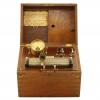
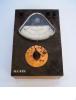
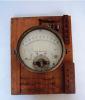
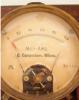
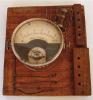
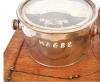
Galvanometer Weston

ELE42.jpg

On the right side of the photo is a heat conductivity apparatus

Electric machine after Wimshurst

ELE41.jpg

The Wimshurst machine is an electrostatic device for generating high voltages developed between 1880 and 1883 by British inventor James Wimshurst (1832 – 1903). It has a distinctive appearance with two large contra-rotating discs mounted in a vertical plane, two cross bars with metallic brushes, and a spark gap formed by two metal spheres.
Ref: http://en.wikipedia.org/wiki/Wimshurst_machine


Electroscope

ELE32.jpg

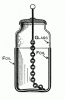
Gold leaf electroscope, used for demonstrate the static electricity of a body when in contact with the brass ball on the top of the instrument.

Switch contact rheostat

ELE34.jpg

The resistance comprises 3 decades of 10x1, 10x10 and 10x100 Ohms, giving a total of 1100 Ohms. At the back of the apparatus are the non-inductively wound redistances. The maximum load is, for the units, 2 Amperes, for the tens, 0.8 Amperes and for the hundreds 0.2 Amperes.

Functioning:
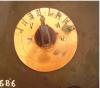
The apparatus is used for resistance measurements. The decades can be used both in series and, by loosening the two connecting bars, seperately in single decades for different circuits. The handle serves as a resistance indicator.

Syndicate content

Copyright National Hellenic Research Foundation - National Observatory of Athens