Thermodynamics

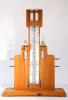
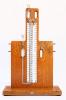
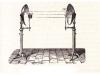
Part of double thermoscope after Looser

THE01.jpg

Two manometers filled with coloured liquid, the long limbs of which are carried upwards quite parallel. A scale graquated in half centimeters admits of easy reading. A second scale is at the back. The sharter limbs of the manometer are cut off by wider vessels each having a cock and an attachment for rubber tubing. By means of the rubber tubing the sensitive air capsules (receivers) are connected with the manometers.
Used for a large number of experiments on heat, electricity etc.

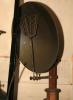
Part of Melloni's bench

THE02.jpg

Brass bar fixed to a base of mahogany wood.
It is a simple optical bench used by Melloni to study the laws of the distribution of radiating heat.
Functioning:
On the bar could be set various components, including lenses, light and heat sources, thermoelectric piles etc. It is used for experiments on radiation, refraction, absorption and reflection of heat.
Macedonio Melloni was a famous Italian physicist of the early nineteenth century.

See also:
http://www.museodifisica.unina.it/eng_coll_melloni.htm#

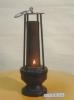
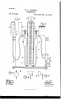
Pyrometer

THE03.jpg

The electric pyrometer was an invention of the German Engineer William Siemens (1823-1883), brother of the founder of the Siemens company, Ernst Werner von Siemens (1816-1892).

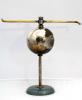
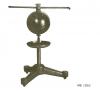
Pair of bulbs after Violle

THE04.jpg

Jules-Louis Gabriel Violle, French physicist (1841-1923).
Two bulbs, consisting o thin sheet cooper, one in dull black on the outside, the other polished and gilt. Both bulbs are jet black internally. Each carries a thermometer divided in 1/5 Celcius.

Functioning:
Used for measuring the thermal radiation of the sun.

This instrument was made in Russia.

Psychometer after Lowe

THE06.jpg

Direct reading psychrometer after Lowe

The psychometer consists of a dry bulb thermometer, a wet bulb thermometer, an index knob and a table which allows the reading of relative humidity, dew point and tension of water-vapour accoring to temperature scales. The parts are fixed on a wooden frame.

Functioning:

Apparatus after Hoffmann

THE07.jpg

Determining the volume of vapour yielded by a given weight of liquid.

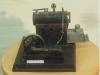
Papin's digester

THE09.jpg

Based on Boyle's law (the volume of a body of an ideal gas is inversely proportional to its pressure) Denis Papin (Papin's statute at the CNAM, Paris1647 - c. 1712) built a bone digester which is a closed vessel with a tightly fitting lid that confines steam until a high pressure is generated. A steam release valve keeps the machine from exploding. The steam machine results from this principle.

http://en.wikipedia.org/wiki/Steam_digester

Syndicate content

Copyright National Hellenic Research Foundation - National Observatory of Athens