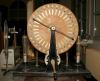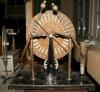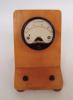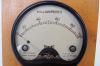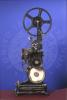
8mm projection device

OPT25.jpg

Made in France (Lens: Japan)

Airpump

AER10.jpg

Airpump for demonstarion of the effects of the vacuum.

Airpump

AER09.jpg

Used at the laboratory of the First Gymansium of Nauplion, one of the first secondary schools of the Greek State.

Amplification circle after Muller

MES01.jpg

It is used to amplify small variations of length.

Anemometer

Anemometer Richard

The anemometer measures the wheel revolutions transforming them in meters. In order to measure the wind speed the observer needs a chronometer (distance/time).

Richard catalogue, 1900, Exposition universelle de Paris

Apparatus after Duboscq

OPT16.jpg

Optical apparatus probably made by Duboscq.

Apparatus after Hoffmann

THE07.jpg

Determining the volume of vapour yielded by a given weight of liquid.

Apparatus after Kruss

OPT12.jpg

The apparatus is probably made by Krüss company.

Apparatus after Morin

MEC02.jpg

Like Atwood's apparatus, the "machine de Morin" demonstates the laws of the free fall.

See: http://www.inrp.fr/she/instruments/instr_mec_morin.htm

Astronomical theodolite

Theodolite Kern

Model DKM3-A
Serial No 188524
The DKM3-A is a variant of the Double Circle Triangulation Theodolite DKM3, the principal changes being those necessary to facilitate the addition of an astronomic micrometer accuracy: The results indicate that the DKM3-A is capable of producing first-order latitude and longitude determinations.

Atmosphere transparency measuring instrument

Atmosphere transparency measuring instrument

"Keilsichtmesser nach Prof. Dr Wigand"
Dr A. Wigand developed in the 1910ies a method for measuring the transparency of the atmosphere. The instrument comprises a prism with varying density.
Serial No 100762

Auto-registering Micrometer

Micrometer Bouty

This Auto-registering Micrometer was used to register stars transits at the Sygros (Gautier) Meridain Circle of the Observatory.
The Photoelecric Photometer attached to the Micrometer (right on the photo) is a G. Rougier model (c. 1925).

Similar instruments:
Observatoire de Paris (Paris inv. 396, anc. 20-28)
Musée de l'Observatoire de Marseille (CM31 IM13000021)

Balance

Balance

The Observatory bought two similar balances in 1899.

Balance after Mohr

HYD01.jpg

The instrument was first described in 1832 by the German chemist Carl Friedrich Mohr. It is a balance with two arms, where the equilibrium is reached by adding weight on a tray. This type of instrument was modified by G. Westphal who replaced the tray with an adjustable counterweight. Used to study the buoyant force.

Balance Barograph

Balance Barograph

The column of mercury is suspended to a bent balance beam with a counterweight. The pressure is proportional to the weight of the mercury in the tube The variation of the pressure are inscribed on a movable board which
thanks to a clockwork slowly descend along the vertical rails.

Copyright National Hellenic Research Foundation - National Observatory of Athens