Demonstration apparatus

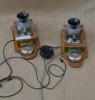
Electric machine after Wimshurst

ELE41.jpg

The Wimshurst machine is an electrostatic device for generating high voltages developed between 1880 and 1883 by British inventor James Wimshurst (1832 – 1903). It has a distinctive appearance with two large contra-rotating discs mounted in a vertical plane, two cross bars with metallic brushes, and a spark gap formed by two metal spheres.
Ref: http://en.wikipedia.org/wiki/Wimshurst_machine


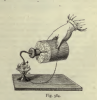
Electroscope

ELE32.jpg

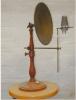
Gold leaf electroscope, used for demonstrate the static electricity of a body when in contact with the brass ball on the top of the instrument.

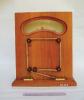
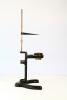
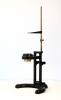
Vertical demonstration galvanometer

ELE37.jpg

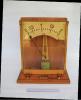
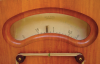
A vertical voltmeter with a fixed coil having a coarse and fine winding with arrestment and a controlling magnet. It can be turned on a tripod.

Functioning:
Galvanometers are sensitive instruments usually used for measuring small currents. They can be used as amperemeters or voltmeters. the instrument is balanced by turning the magnet over the coil.

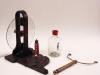
Leyden jar

ELE38.jpg

Used for Physics education at the First Gymasium of Athens, Plaka.

A Leyden jar is a condenser that consists of two metal-foil coatings on the inside and outside of a stoppered glass jar. A bronze rod passes through the stopper and is connected to the foil coating on the inside of the jar. The free end of the rod forms a small sphere.

Functioning:

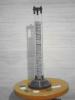
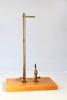
Glass bar for experiments in static electricity

ELE22.jpg

The glass bar is used in order to insulate a curved bronze conductor with a spherical end.

Functioning:
The glass insulator allows for collection and transport of electrical charges in order to use them in electrostatic experiments.

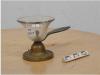
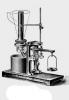
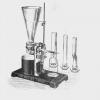
Electrolytic apparatus

ELE24.jpg

Used during the end of the 19th and the beginning of the 20th cent. at the Commercial School of Volos, to demonstrate electrolysis.

Electric machine after Ramsden

ELE27.jpg

This electric machine was used for demonstartions at the Gymnasium of Nauplion, one of the first Gymnasiums of the Greek State.

Syndicate content

Copyright National Hellenic Research Foundation - National Observatory of Athens