Telescopes
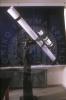
Refractive telescope Polarex
Refractive telescope with equatorial mounting, objective diameter 125mm, focal length 2000m, photographic objective diameter 80mm
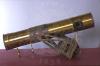
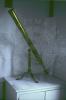
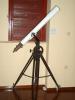
Portable reflective telescope
Reflecting telescope, Newtonian type, used for educational purposes at the University of Athens.
Originally mounted on a tripod, the eyepiece is missing.
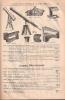
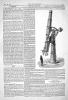
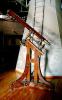
Refracting telecsope
This small refractor was used by the Greek scholar Theophilos Kairis (1784-1853). One of the first telescopes for amateur stellar observations used in Greece.
Meridian Circle
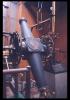
The Gautier Meridian Circle was bought in 1899 with the funds gathered by the Commission for the funding of the Observatory which was established in 1896 by Demetrius Eginites, Director of the Observatory. The expenses for the purchase and the installation were provided by the Greek of Diaspora, Andreas Sygros (a total of 50,000 golden Francs; the price of the instrument was 26,600 golden Francs). The astronomer of the Observatory of Paris, Loevy was charged to supervise Gautier’s construction of the Meridian.
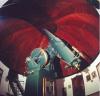
Newall Refractor
The Newall telescope is the most impressive instrument of the Observatory of Athens. It was named after Robert Stirling Newall (1812-1889), an amateur astronomer, who, due to his successful entrepreneurial activities in the field of steam engines and telegraphic wires, became rather affluent.
In 1862, Newall discovers by change two large-sized crystals made of crown and flint glass, produced by Chance of Birmigham. He bought these and entrusted T. Cooke and Sons with the construction of the biggest refracting telescope of its time. The telescope was completed in 1869.
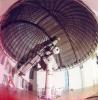
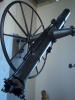
Dorides Refracting Telescope
This is, undoubtedly, one of the classic scientific instruments of the Observatory. It was used continuously from 1901; nowadays, however, the sky over Attica is rather unaccommodating, and thus its use has been restricted to demonstrations for the public. Until 1960, when the Newall telescope was acquired, Doridis’ telescope was the largest one in the Observatory.
Refracting telescope
Private telescope of Professor Stavros Plakides, former Director of the Observatory. Used for solar Observations until the 1950ies mounted on the Ploessl mounting.
S. Plakides observing the Sun with the Secrétan refractor (c.1930)
Refracting telescope
This robust and easily transportable telescope was used for Observatory's missions to observe solar eclipses: 19th June 1936 near Lavrion (Greece), 25th February 1952 (Sudan) and 15th February 1961 (Dalmatian coast).
Observation of the Solar eclipse of 19th June 1936 at Cape Thorikon, Laurion, Greece
Meridian Telescope
This is one of the first instruments of the Observatory of Athens. It belongs to part of the Georgios Sinas donation. It was exhibited, in 1845, at the Vienna exhibition of scientific instruments and in 1847, G. Vouris, the first director of the observatory, brought it to Athens among other instruments.
Refracting Telescope
Technical description:
Refracting telescope.
Mounting : German equatorial (steel axis).
Lens : Fraunhofer type Achromatic doublet 158mm.
Focal ratio : f/15.
History:
This is one of the most monumental instruments of the Observatory, excellent for planetary observations. Julius Schmidt used this telescope to perform the necessary observations that led to his charting the best part of the famous Map of the Moon.