Time and Longitude

Marine chronometer

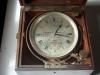
Dobbie McInnes chronometer

The makers, Dobbie McInnes Co. traces their roots back to the beginning of the 20th century when shipbuilding on the river Clyde was thriving. They were appointed as ‘Instrument Makers and contractors to the British Admiralty’ producing accurate chronometers to calculate longitudes. Serial No 9602.

See http://www.mhs.ox.ac.uk/database/brief.htm?Invno=44156&NumberOfImage=1

Electric pendulum

Brille electric pendulum

First made in 1910, the electric pendulum Brillé is in fact a “mother clock” which produces pulses in order to command secondary clocks.
It consists of a fixed spool through which passes the beam of the clock consisting of a magnet. This magnet transmits to the spool the pulse producing in its turn an electromagnetic pulse which maintains the oscillation.
The mother clock has its own mechanical movement. It delivers electric pulses to secondary clocks. This idea permitted to distribute hour at a distance with a perfect accuracy.

Sextant

Hughes sextant 1938

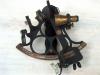
Marine sextant, 6" radius and reading to 10", with 2 1/2x telescope magnification and battery operated light. Felt lined dovetail box includes original certificate of inspection, dated 16/6/1942.
This is sextant # 29792 and carries the "HUSUN" trademark plate of Henri Hughes and son.

Donated by Kostas Aggelakis
to the Hellenic Archives of Scientific Instruments. The box and the certificate of inspection

Sextant

AST11.jpg

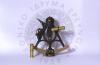
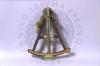
The sextant consists of a triangular frame, an index arm which can be moved across the bottom arced limb, two sights and two reflecting mirrors. One mirror is moved with the arm, and the other (half of which is transparent) is fixed to one limb. One sight is fixed below this mirror and the other on the opposite limb. The arc of the bottom limb is 60degrees and a venier scale on the index arm allows for more accurate reading.

Functioning:

Sextant

AST10.jpg

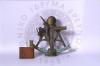
The sextant consists of a triangular frame, an index arm which can be moved across the bottom arced limb, two sights and two reflecting mirrors. One mirror is moved with the arm, and the other (half of which is transparent) is fixed to one limb. One sight is fixed below this mirror and the other on the opposite limb. The arc of the bottom limb is 60degrees and a venier scale on the index arm allows for more accurate reading.

Functioning

Octant

AST12.jpg

The sextant consists of a triangular frame, an index arm which can be moved across the bottom arced limb, two sights and two reflecting mirrors. One mirror is moved with the arm, and the other (half of which is transparent) is fixed to one limb. One sight is fixed below this mirror and the other on the opposite limb. The arc of the bottom limb is 45degrees and a venier scale on the index arm allows for more accurate reading.

Functioning:

Meridian Circle

AST84 Meridian Circle Sygros (Gautier)

The Gautier Meridian Circle was bought in 1899 with the funds gathered by the Commission for the funding of the Observatory which was established in 1896 by Demetrius Eginites, Director of the Observatory. The expenses for the purchase and the installation were provided by the Greek of Diaspora, Andreas Sygros (a total of 50,000 golden Francs; the price of the instrument was 26,600 golden Francs). The astronomer of the Observatory of Paris, Loevy was charged to supervise Gautier’s construction of the Meridian.

Chronographer

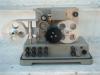
Chronographer Favag

Type 17.5110.01/44
fab. No 1197026

Pendulum clock

Pendulum clock Fénon

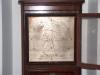
The Fénon clock was ordered in 1899 to serve at the new Gautier Meridian Circle of the Observatory of Athens. It replaced the Berthoud (c. 1810) and Kessels (1846) clocks for the Meridian observations. The clock is fixed on a marble base independent of the floor of the building in order to avoid vibrations. The clock was used by the Observatory time service until the 1950ies.
Serial No 55.

Pendulum clock

Pendulum clock Kessels

The instrument was bought in Vienna by the first director of the Observatory, George Vouris. Together with the clock Berthoud, it was used at the meridian circle to determine Athens’ time and to regulate marine and civil clocks.

Extract from 1921 Observatory Internal Code, article 25:

Syndicate content

Copyright National Hellenic Research Foundation - National Observatory of Athens